
Access to AI is equal. Outcomes are not.
Artificial intelligence is no longer a future technology waiting to enter the workplace. It is already embedded in how organisations research, write, analyse, communicate and make decisions.
The critical story is not that AI exists, nor that it is broadly available. It is the widening gap between the work AI could improve and the work that is actually being transformed, this is the AI Exposure Gap.
For leading organisations, the constraint is no longer access to tools. Powerful AI systems are available to almost every business. The real challenge is converting that exposure into measurable outcomes through three disciplines: capability, trust and governance.
Organisations that build AI capability, earn trust in its use and govern it well will turn exposure into productivity, sharper decisions and durable competitive advantage.
Organisations that do not will fall behind, despite having access to exactly the same technology.
AI Exposure Is Not the Same as AI Adoption:
Global evidence is beginning to provide a clearer picture of how AI is being used in practice.
Anthropic’s Economic Index analysed millions of anonymised Claude interactions and mapped them against occupational tasks. The findings suggest AI usage is already present across a broad range of occupations, with approximately 36% of occupations showing AI use across at least a quarter of their associated tasks.
This is not theoretical modelling – it is observed workplace behaviour! However, the same research reveals an important distinction. AI exposure does not automatically translate into automation.
Anthropic found that approximately 57% of AI interactions were augmentative, helping people learn, draft, research, summarise, analyse or improve existing work. Around 43% were more automation-oriented, where AI completed tasks with limited human involvement.
The implication is significant. The first major wave of AI adoption is not about replacing workers. It is about amplifying them.
The AI Exposure Gap
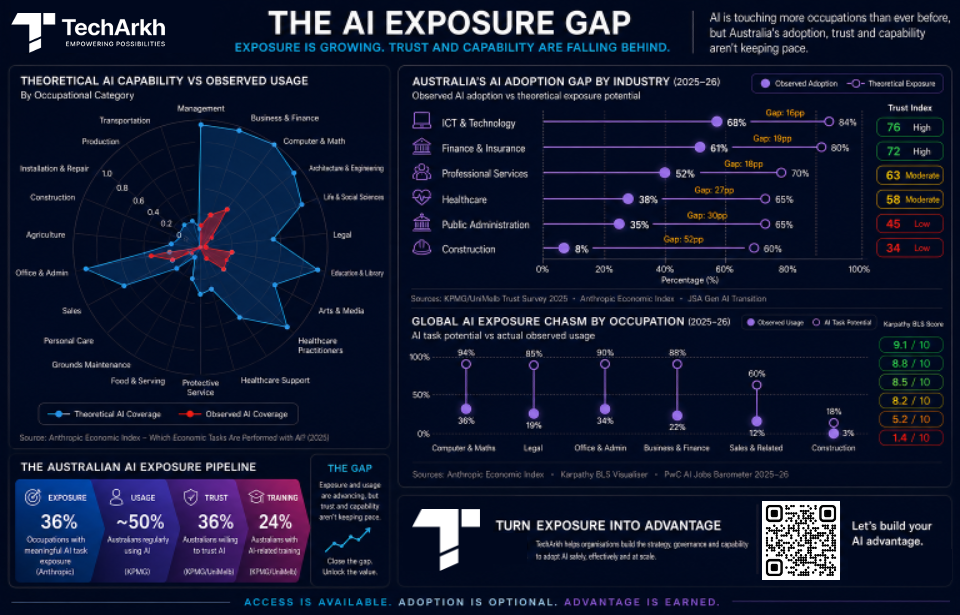
Source: Anthropic Economic Index, KPMG/University of Melbourne Trust in AI Study 2025
The chart highlights a growing disconnect:
- Exposure is increasing
- Usage is growing
- Trust remains low
- Training remains lower still
This creates a structural challenge for organisations.
Workers are increasingly encountering AI in their day-to-day activities, but many organisations have not yet established the policies, training programs and governance frameworks required to support safe and effective adoption.
The result is an environment where AI capability often develops faster than organisational readiness.
The Karpathy Exposure Framework:
Former OpenAI researcher and AI leader Andrej Karpathy offers a useful lens for understanding AI exposure.
Rather than focusing on industries, Karpathy focuses on the nature of work itself.
Roles involving digital inputs and digital outputs are inherently easier for AI systems to assist. Activities such as writing, coding, financial analysis, legal review, administration, reporting and knowledge management all occur within environments where information can be created, processed and transformed digitally.
By contrast, work requiring physical interaction with people, equipment or environments remains significantly harder to automate.
This creates what could be described as a cognitive exposure curve.
The first major wave of AI impact is not concentrated in factories or manual labour. It is concentrated in knowledge work. Software developers, consultants, accountants, lawyers, analysts, project managers, administrators and executives are among the occupations experiencing the highest levels of AI exposure today.
For organisations, this represents a substantial opportunity. The greatest gains are likely to come not from replacing workers but from enabling them to operate at higher levels of productivity, accuracy and effectiveness.
Trust Is Becoming the Constraint:
While AI exposure continues to grow, trust remains a significant challenge.
The KPMG and University of Melbourne global study on trust, attitudes and the use of artificial intelligence found that Australia ranks among the more cautious markets globally.
The Australian findings revealed:
- Approximately 50% of Australians regularly use AI.
- Only 36% are willing to trust AI systems.
- Just 24% have received AI-related training.
- A significant majority remain concerned about potential negative outcomes.
This creates a practical challenge for business leaders.
Employees are increasingly experimenting with AI regardless of organisational readiness.
Without clear governance, approved tools and role-specific guidance, workers are often left to determine acceptable usage on their own.
This typically leads to one of three outcomes:
- AI avoidance.
- Unauthorised AI use.
- Poor AI use.
All three outcomes carry risk.
Avoidance limits productivity gains. Unauthorised use creates compliance and security concerns. Poor use undermines trust and reinforces scepticism.
The result is a self-perpetuating cycle where low trust slows adoption, limited adoption reduces demonstrated value and the absence of visible value further suppresses trust.
This is the real AI exposure gap facing organisations.
The Labour Market Is Already Pricing AI Capability:
PwC’s 2025 AI Jobs Barometer suggests that markets are already rewarding AI capability.
The research found that industries with higher AI exposure are experiencing stronger productivity and revenue growth than less exposed sectors. Workers with AI-related skills are also commanding increasing wage premiums as organisations compete for talent capable of working effectively alongside AI systems.
This does not mean AI-exposed jobs are disappearing. It means AI fluency is becoming an increasingly valuable capability.
The organisations that succeed over the next decade will not necessarily be those with the most advanced technology. They will be those that build the strongest organisational capability around that technology.
What Leaders Must Do Next:
The evidence from Anthropic, Jobs and Skills Australia, KPMG, the University of Melbourne, PwC and broader industry research points towards a clear conclusion.
The challenge is not access – It is adoption.
1. Invest in Role-Based AI Capability
- Generic AI awareness programs are no longer sufficient.
- Employees need practical examples relevant to their specific responsibilities, workflows and business outcomes.
- Capability building should focus on real work, not theoretical concepts.
2. Establish Practical AI Governance
Policies should provide clear guidance on:
- Approved tools
- Acceptable data usage
- Human review requirements
- Accountability for decisions
- Escalation processes
- Compliance obligations
Effective governance enables adoption rather than restricting it.
3. Focus on High-Value Use Cases
Successful organisations prioritise use cases that are:
- Document-heavy
- Repetitive
- Measurable
- Low-risk
- Easy to scale
Early wins build organisational confidence and accelerate broader adoption.
4. Measure Outcomes, Not Activity
The objective is not simply increasing AI usage.
The objective is improving business performance.
Leaders should measure:
- Productivity gains
- Quality improvements
- Reduction in rework
- Employee confidence
- Customer outcomes
- Risk reduction
Trust grows when outcomes become visible.
The Strategic Choice Facing Australian Organisations:
The next phase of AI adoption will not be won by organisations that simply provide access to technology.
Access is rapidly becoming commoditised. The advantage will belong to organisations that transform exposure into capability.
That requires leadership, governance, training and operational discipline.
Organisations does not lack AI tools. It does not lack AI opportunity.
What many organisations still lack is a structured pathway from experimentation to enterprise capability.
The businesses that close that gap first will not simply use AI more. They will use it better.
And in an increasingly competitive market, that difference may prove decisive.
How TechArkh Can Help:
TechArkh helps organisations simplify complexity and transform technology investments into measurable business outcomes.
Through our strategic advisory, delivery and managed services, we help leaders:
- Develop practical AI strategies
- Establish governance frameworks
- Identify high-value use cases
- Build workforce capability
- Implement AI responsibly and securely
If your organisation is ready to move beyond experimentation and build a scalable AI capability, TechArkh can help define the roadmap, governance and execution approach needed to realise value.
Speak to us to learn more about our ArkhAI services offerings and how we can help you govern with confidence.
ArkhAI. Simplify Complexity. Realise Value. Scale Responsibly.
© TechArkh | Executive Services | ArkhAI Services
References:
- Anthropic Economic Index — Labor Market Impacts
- Anthropic Economic Index March 2026 Report
- Which Economic Tasks are Performed with AI? (arXiv)
- Andrej Karpathy — US Job Market Visualizer
- CSEP: Evaluating Karpathy’s Exposure Dashboard
- Jobs and Skills Australia — Our Gen AI Transition
- KPMG / University of Melbourne — Trust in AI Global Insights 2025
- PwC AI Jobs Barometer Australia
- Australian Government AI Adoption Insights
- OECD — Who Will Be the Workers Most Affected by AI?