The foundation to a unified and reliable source of truth for IT Operations.
IT environments today are growing increasingly complex. Organisations are deploying a mix of cloud, on-premises, and hybrid systems to support their operations & to also keep their costs down. Managing these diverse assets efficiently requires a single, accurate, and centralised source of truth – and that’s exactly what the Configuration Management Database (CMDB) in ServiceNow delivers.
A well-implemented CMDB empowers businesses to gain complete visibility into their IT ecosystem, ensuring that decision-making is backed by reliable data. Let’s explore how CMDB enhances IT operations and why it’s a critical component for achieving operational excellence.
What is a Configuration Management Database (CMDB)?
A CMDB is a centralised repository that stores information about an organisation’s IT assets, also known as configuration items (CIs). These assets can include hardware, software, applications, networks, and cloud services.
The CMDB tracks relationships between these configuration items, providing a holistic view of how different components interact and depend on one another. This visibility is essential for managing changes, preventing downtime, and optimising IT services.
CMDB Architecture
The architecture of the ServiceNow’s Configuration Management Database (CMDB) is crafted to manage and optimise complex IT environments through a robust & streamlined framework for organising, managing & in depth analysis of configuration data with precision and efficiency. It seamlessly integrates with other ITSM processes within the ServiceNow platform & ensures a consistent flow of data offering unparalleled visibility into all IT assets. The CMDB’s modular design allows flexible customisation and scalability, empowering organisations to adapt & expand the system to meet their unique and evolving requirements.
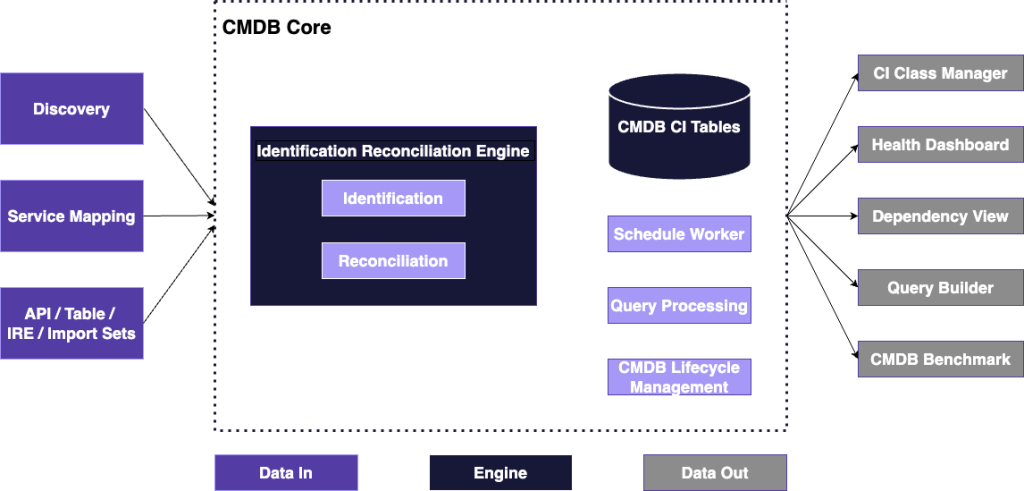
How ServiceNow CMDB Works?
CMDB integrates seamlessly with other elements in the IT landscape, such as Incident Management, Change Management and Asset Management. Here’s a high-level view of how it works:
- Service Mapping: Creates a dynamic map of your IT services and their supporting assets
- Discovery: Automatically identifies and maps IT assets across your organisation’s infrastructure
- Dependency Mapping: Identifies relationships and dependencies between different configuration items
- Reconciliation: Ensures data accuracy by resolving conflicts and duplications
Key Benefits of a CMDB:
1. Centralised Source of Truth
CMDB acts as a unified, reliable source of truth for all IT assets. By maintaining accurate and up-to-date data, organisations can reduce the risk of errors, improve compliance, and streamline IT operations.
2. Improved Change Management
Understanding the relationships between CIs helps IT teams predict the impact of changes before they occur. This reduces the risk of disruptions during updates or maintenance and ensures smoother change management processes.
3. Enhanced Incident and Problem Management
When incidents occur, the CMDB provides valuable context about affected assets and their dependencies. This helps IT teams resolve issues faster by identifying root causes and preventing future occurrences.
4. Streamlined Compliance and Audits
A well-maintained CMDB ensures that organisations can easily track and document IT assets, simplifying compliance with industry regulations and standards.
5. Informed Decision-Making
With a comprehensive view of IT assets and their relationships, leaders can make data-driven decisions to optimise performance, reduce costs, and improve service excellence & delivery.
Common Pitfalls in Implementing a CMDB:
While a CMDB offers significant benefits, organisations often face challenges during implementation:
- Data Accuracy: Maintaining accurate and up-to-date data requires ongoing effort
- Data Overload: Without proper scope, a CMDB can become bloated with unnecessary information
- Lack of Governance: A lack of governance policies can result in inconsistent data entry and management practices
To overcome these challenges, it’s essential to establish clear governance policies, define the scope of the CMDB, and leverage automation tools to maintain accuracy.
TechArkh’s Best Practices for Optimising Your ServiceNow CMDB:
- Define Your Scope: Focus on critical assets and their dependencies to avoid unnecessary data flow
- Automate Discovery: Use ServiceNow’s discovery tool to automatically identify and update configuration items
- Data Normalisation & Reconciliation: Implement simplified processes to normalise and reconcile data from multiple sources, ensuring consistency and reliability in the CMDB
- Establish Governance: Implement policies for data entry, updates, and maintenance to ensure consistency
- Regular Audits: Conduct periodic audits to maintain data accuracy and relevance.
- Leverage Service Mapping: Utilise service mapping to visualise and manage relationships between IT services and assets
Conclusion:
ServiceNow CMDB is more than just a database, it’s the foundation for a reliable IT operations. By providing a single source of truth for all IT assets and their relationships, it empowers organisations to make informed decisions, manage changes effectively, and optimise service delivery.
In a world where IT environments are becoming increasingly complex, a well-implemented CMDB is essential for achieving operational excellence and driving business success.
Ready to take your IT operations to the next level? Explore how TechArk can transform your business transform today. We have extensive experience in Implementing complex CMDB’s in enterprise & industrial environments locally and globally.
Speak to us to know more about our Enterprise Service Management solutions and how we can help you implement a powerful CMDB to drive your IT operations forward.
© TechArkh | Enterprise Service Management | IT Operations Management – ITOM